trading
News and Social Signal: Incorporating Headlines into Probability Estimates
- trading
- kalshi

News and Social Signal: Incorporating Headlines into Probability Estimates

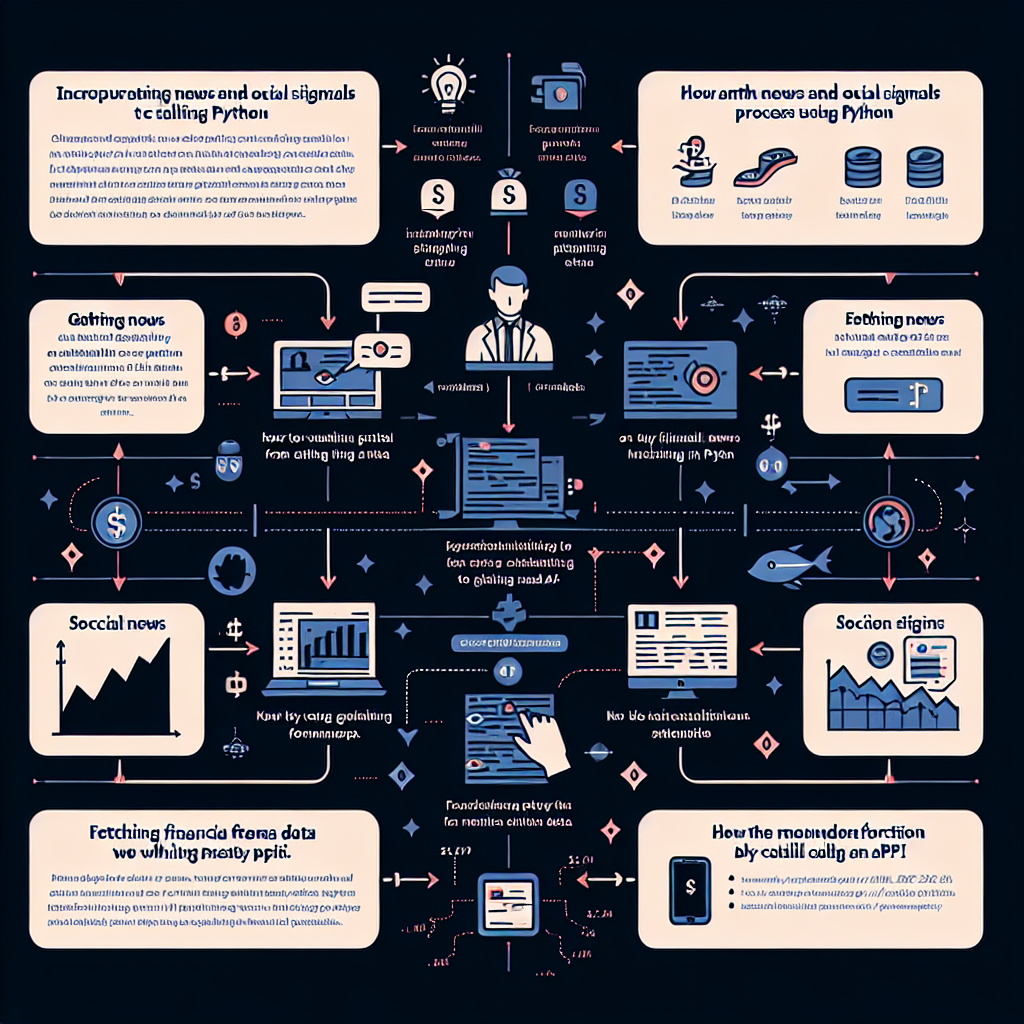
In the rapidly evolving landscape of quantitative trading, integrating real-time news and social media signals into probability estimates has emerged as a critical factor for success. The ability to incorporate headlines into predictive models can enhance decision-making processes and provide an edge in trading strategies. This article will delve into why and how to account for news and social signals, complete with examples in Python and insights into market structure.
Understanding the Impact of News on Markets
The Role of News in Price Movements
Markets react to news; this reaction is often swift and pronounced. For example, a company reporting worse-than-expected earnings can lead to a substantial drop in its stock price. Conversely, a positive economic report can drive indices higher. News can create volatility and influence trader sentiment, making it crucial to factor these signals into probability estimates.
Social Media: An Emerging Signal
With the explosion of platforms like Twitter and Reddit, social media has become a valuable source of market sentiment. Social signals often lead to price movements, as observed during events like the GameStop saga in early 2021. Understanding the sentiment from these platforms can improve predictive models when incorporated effectively.
Designing a News-Driven Probability Model
Data Acquisition
To start incorporating news and social signals, you'll first need to gather data from reliable sources. For financial news, you might consider APIs from services such as NewsAPI or scraping news websites. For social media, Twitter offers an API to extract tweets and sentiment data. Here’s how you can gather data using Python.
import requests
def fetch_news(api_key, query, from_date, to_date):
url = f'https://newsapi.org/v2/everything?q={query}&from={from_date}&to={to_date}&sortBy=publishedAt&apiKey={api_key}'
response = requests.get(url)
return response.json()
news_data = fetch_news('your_api_key', 'AAPL', '2023-01-01', '2023-10-01')
This sample code fetches news articles for Apple Inc. within a specified date range, giving you a solid foundation for incorporating headlines into your trading strategy.
Sentiment Analysis
Once the data is collected, the next step is to perform sentiment analysis to quantify the tone of the headlines. Libraries like TextBlob or VADER can be helpful.
from textblob import TextBlob

def analyze_sentiment(headlines):
    sentiments = []
    for headline in headlines:
        analysis = TextBlob(headline)
        sentiments.append(analysis.sentiment.polarity)  # Range: -1 to 1
    return sentiments

headlines = [article['title'] for article in news_data['articles']]
sentiment_scores = analyze_sentiment(headlines)
The sentiment_scores list can now be used as an additional feature in your probability model, signifying the overall sentiment of the news related to a particular asset.
Building a Probability Model: Integration
With the sentiment scores prepared, the next step is integrating them into your probability model. A commonly used model in probability estimation is logistic regression, which analyzes how dependent variable probabilities are affected by independent variables.
Model Creation
Using libraries like scikit-learn, you can train a logistic regression model incorporating the sentiment score and other factors.
from sklearn.model_selection import train_test_split
from sklearn.linear_model import LogisticRegression
import pandas as pd

# Create a DataFrame with historical price changes and sentiment scores
data = pd.DataFrame({
    'price_change': price_changes,  # Historical price change indicators
    'sentiment_score': sentiment_scores
})

X = data[['sentiment_score']]
y = (data['price_change'] > 0).astype(int)  # Binary outcome: 1 if price goes up, else 0

X_train, X_test, y_train, y_test = train_test_split(X, y, test_size=0.2, random_state=42)

model = LogisticRegression()
model.fit(X_train, y_train)

accuracy = model.score(X_test, y_test)
print(f'Model Accuracy: {accuracy:.2f}')
This code snippet implements logistic regression using sentiment scores and historical price changes as input features. After fitting the model, you can evaluate its accuracy to refine your approach.
Enhancing Market Structure Understanding
Real-Time Data Processing
The challenge of operating on real-time data can be daunting. It is essential to have a robust data pipeline that collects news, social signals, and market data in a timely manner. Using frameworks like Kafka for message streaming can facilitate this process.
from kafka import KafkaProducer
import json

producer = KafkaProducer(bootstrap_servers='localhost:9092', value_serializer=lambda v: json.dumps(v).encode('utf-8'))

def send_data_to_kafka(news_data):
    for article in news_data['articles']:
        producer.send('news_topic', article)

send_data_to_kafka(news_data)
This snippet demonstrates how to publish news articles to a Kafka topic for real-time ingestion into your model, ensuring rapid response to unfolding events.
Incorporating Market Microstructure
Understanding how news and social signals fit within market microstructure is crucial for traders and quantitative analysts. You can analyze bid-ask spreads, order book dynamics, and volume changes before and after significant news releases. Including these factors as features in your model may result in more comprehensive probability estimates.
Practical Application and Backtesting
Integrating news and social sentiment into a trading strategy provides actionable insights but requires robust backtesting to validate performance. Using a framework like Backtrader, you can create a systematic strategy that trades on sentiment-driven signals.
import backtrader as bt

class SentimentStrategy(bt.Strategy):
    def __init__(self):
        self.sentiment = self.datas[0].sentiment_score

    def next(self):
        if self.sentiment[0] > 0.1:
            self.buy()
        elif self.sentiment[0] < -0.1:
            self.sell()

# Instantiate Cerebro engine and add data feeds
cerebro = bt.Cerebro()
cerebro.addstrategy(SentimentStrategy)
cerebro.run()
This example illustrates a simple strategy that executes trades based on sentiment scores. Backtesting can help quantify the effectiveness of this strategy across different market conditions.
Conclusions
Incorporating news and social signals into probability estimates can enhance quantitative trading strategies by providing deeper insights into market dynamics. By leveraging data acquisition techniques, sentiment analysis, and robust modeling frameworks, you can build a system that reacts to market-moving signals effectively. Always remember the importance of backtesting to validate your strategy and ensure that it performs well under various market conditions.
With the rapid pace of information in today's market, the integration of headlines into your trading models is not just advantageous—it's becoming essential. By remaining ahead of the curve, you can position your trading systems for long-term success.